The Journal By Nick·June 29, 2025· 5 min read
Bioceramic Scuba Fifty Fathoms Green Abyss Review | VELOCE
By Nick·June 29, 2025· 5 min readSwatch Group once again reached into its prestigious portfolio and paired its most accessible brand with one of its most revered: enter the Swatch x Blancpain Bioceramic Scuba Fifty Fathoms.
0 views
IN THIS ARTICLE
The Swatch x Blancpain "Ocean of Storms": More Than Just Hype?
When Swatch and Omega launched the Moonswatch, the watch world was thrown into a frenzy. It was a collaboration that no one saw coming, democratizing an iconic design and creating a cultural phenomenon that delighted many a dialhead. Lightning, it was said, wouldn't strike twice. Yet, in September 2023, it arguably did. Swatch Group once again reached into its prestigious portfolio and paired its most accessible brand with one of its most revered: enter the Swatch x Blancpain Bioceramic Scuba Fifty Fathoms. This time, the focus wasn't on the stars, but the deep. And perhaps no model in the five-piece launch collection better encapsulates the blend of heritage and modern material science than the stark, stylish "Ocean of Storms."
But beyond the initial hype and the inevitable queues, what is this watch really about? Is it a worthy tribute to the grandfather of all modern dive watches, or a clever marketing exercise in a plastic case? As a watch journalist, I've seen these collaborations come and go. This one, however, feels different. It's a conversation starter, a polarizing piece that forces us to examine what we value in a timepiece: history, mechanics, material, or pure, unadulterated fun.
"The collection is a tribute to the first true diver's watch, the Fifty Fathoms, which was created 70 years ago by a passionate scuba diver." - Swatch Group
A Nod to History: The Fifty Fathoms Legacy
To understand the "Ocean of Storms," one must first appreciate its ancestor. The Blancpain Fifty Fathoms, born in 1953, wasn't just *a* dive watch; it was arguably *the* dive watch. Developed at the behest of Captain Robert "Bob" Maloubier, commander of the French combat diving corps, it established the blueprint for the genre. Key features we now take for granted—a unidirectional rotating bezel for timing dives, a high-contrast dial with luminous markings for legibility, and superior water resistance—were all pioneered by the Fifty Fathoms.
The name itself was a mark of its capability: "Fifty Fathoms" equals approximately 91.44 meters, the maximum depth a diver could reach with the oxygen technology of the era. This was a purpose-built tool, not a luxury item, and its adoption by numerous naval forces, including the US Navy SEALs, cemented its legendary status. The "Ocean of Storms" model specifically pays homage to the Fifty Fathoms models of the late 1960s, particularly those with the bold, blocky indices and the stark black-and-white color scheme.
The "Ocean of Storms" Deconstructed
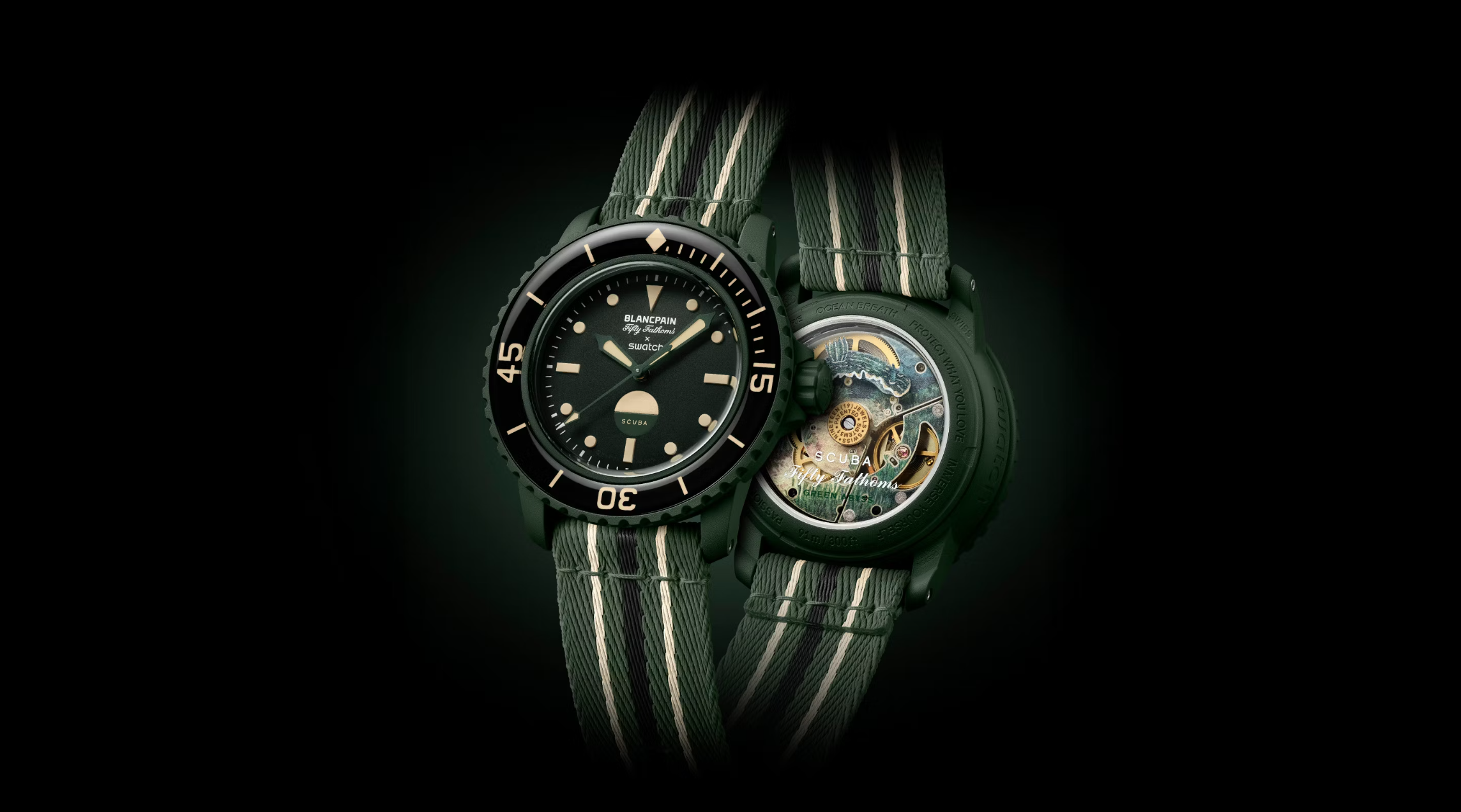
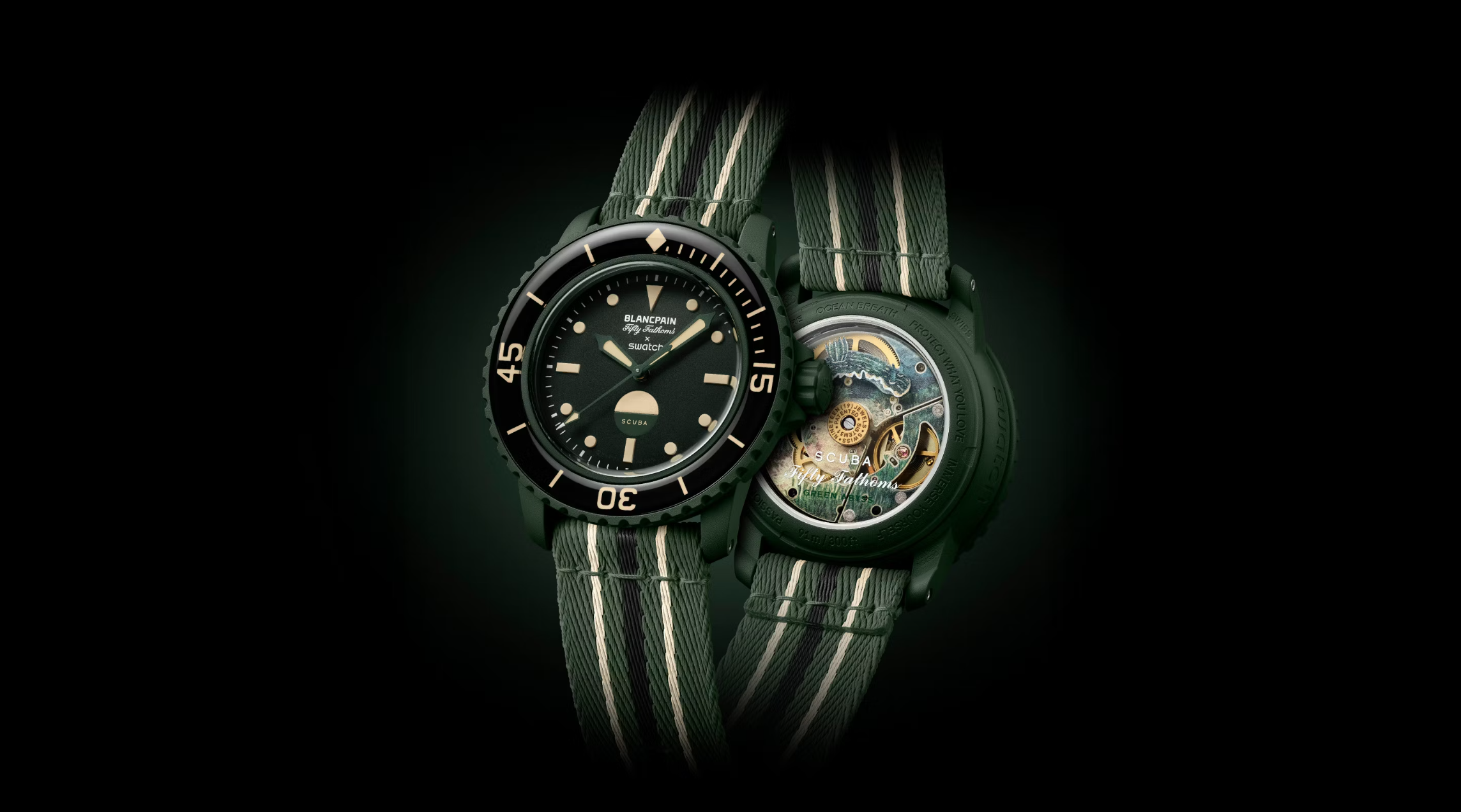
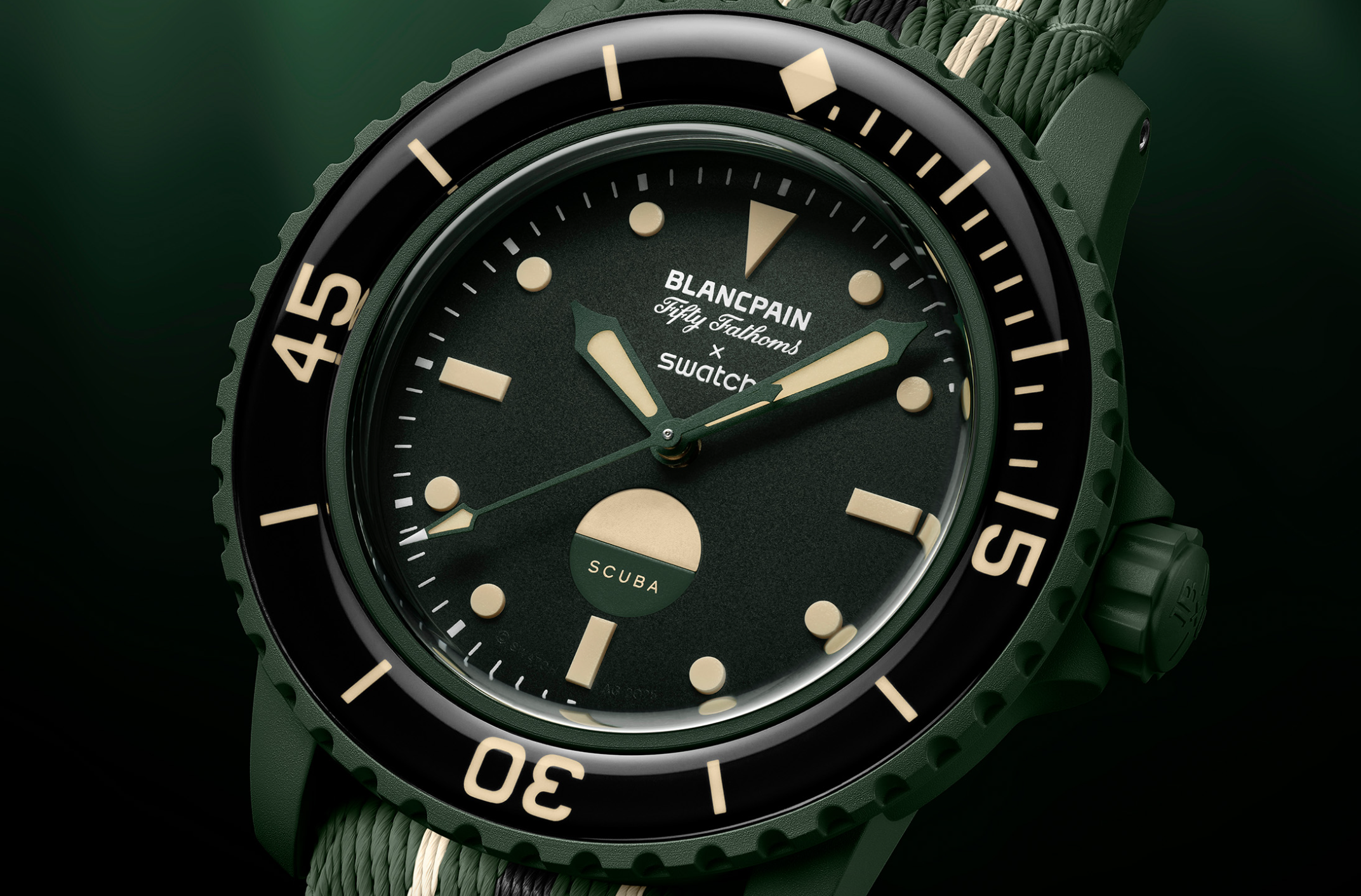
At first glance, the "Ocean of Storms" is a faithful homage. The 42.3mm case diameter and 48mm lug-to-lug distance are modern, yet wearable, and the overall silhouette is unmistakably Fifty Fathoms.
But this is where the Swatch influence takes over.
The Bioceramic Case: The entire case is crafted from Swatch's proprietary Bioceramic, a blend of two-thirds ceramic and one-third bio-sourced plastic derived from castor oil. This results in a watch that is silky to the touch, surprisingly lightweight, and yet feels more substantial and scratch-resistant than plain plastic. The matte black finish of the "Ocean of Storms" gives it a stealthy, utilitarian feel that suits its tool-watch inspiration.
The Dial and Bezel: The dial is a sunray brushed black, adding a touch of dynamism to the otherwise monochromatic design. The applied indices and hands are generously filled with Grade A Super-LumiNova for excellent low-light visibility, a non-negotiable for a dive watch homage. The unidirectional bezel, also in black Bioceramic, has a satisfying 120-click action and a luminous pip at 12 o'clock.
The Heart of the Matter: SISTEM51
Perhaps the most impressive aspect of this collaboration is what lies beneath the exhibition caseback. Unlike the quartz-powered Moonswatch, the Scuba Fifty Fathoms is powered by Swatch's SISTEM51 automatic movement. This revolutionary caliber, introduced in 2013, is made entirely by machine on an automated assembly line and consists of only 51 parts held together by a single central screw. It boasts an impressive 90-hour power reserve and is anti-magnetic thanks to its Nivachron hairspring.
For the "Ocean of Storms," the movement is digitally printed with an image of the Oceanus Procellarum (the "Ocean of Storms" on the moon) and a corresponding nudibranch, the Okenia Luna. This playful touch is pure Swatch and a delightful easter egg for the owner.
Is It a "Real" Dive Watch?
Herein lies the debate. With a water resistance of 50 fathoms (91 meters), a unidirectional bezel, and a screw-down crown, the "Ocean of Storms" meets the basic criteria. The NATO strap, made from recycled fishing nets, is perfectly suited for water. However, the Bioceramic case, while durable for daily wear, wouldn't be the first choice for serious underwater exploration compared to stainless steel or titanium. Furthermore, the SISTEM51 movement is hermetically sealed and cannot be serviced, only replaced—a point of contention for traditional watchmakers.
The verdict? It's a "scuba" watch, as the name implies. It's perfectly capable of handling swimming, snorkeling, and recreational diving. For the vast majority of buyers, its capabilities are more than sufficient. It captures the *spirit* of the Fifty Fathoms, even if it's not a direct replacement for the professional-grade tool.
Current Relevance and Final Thoughts
The Swatch x Blancpain Bioceramic Scuba Fifty Fathoms "Ocean of Storms" is a masterclass in collaboration. It successfully translates the design language of an icon into a completely different material and price point ($400 USD at launch) without feeling like a cheap copy. It introduces the legendary story of the Fifty Fathoms to a new generation of enthusiasts who may never have considered a four- or five-figure luxury watch.
Is it perfect? No. The unserviceable movement will bother purists, and the Bioceramic case will never have the heft and permanence of steel. But to judge it by those standards is to miss the point. This is not a Blancpain. It's a Swatch. It's meant to be fun, accessible, and a little bit disruptive. The "Ocean of Storms," with its moody, monochromatic aesthetic, is arguably the most versatile and serious-looking of the collection, offering a taste of horological history in a thoroughly modern package. It proves that lightning can, in fact, strike twice.
GALLERY
WRITTEN BY
Nick
I originally started VELOCE to put my skills to work, hone my app design and web development practices, and dive deeper into the world of horology. I wanted to learn more about the watches, the brands, and the incredible people behind them - the creators, the designers, and the collectors. I love discovering new timepieces and sharing their stories with the world. VELOCE is my ultimate passion project and hobby, the creative space I head to after my full-time job to build something I truly care about.