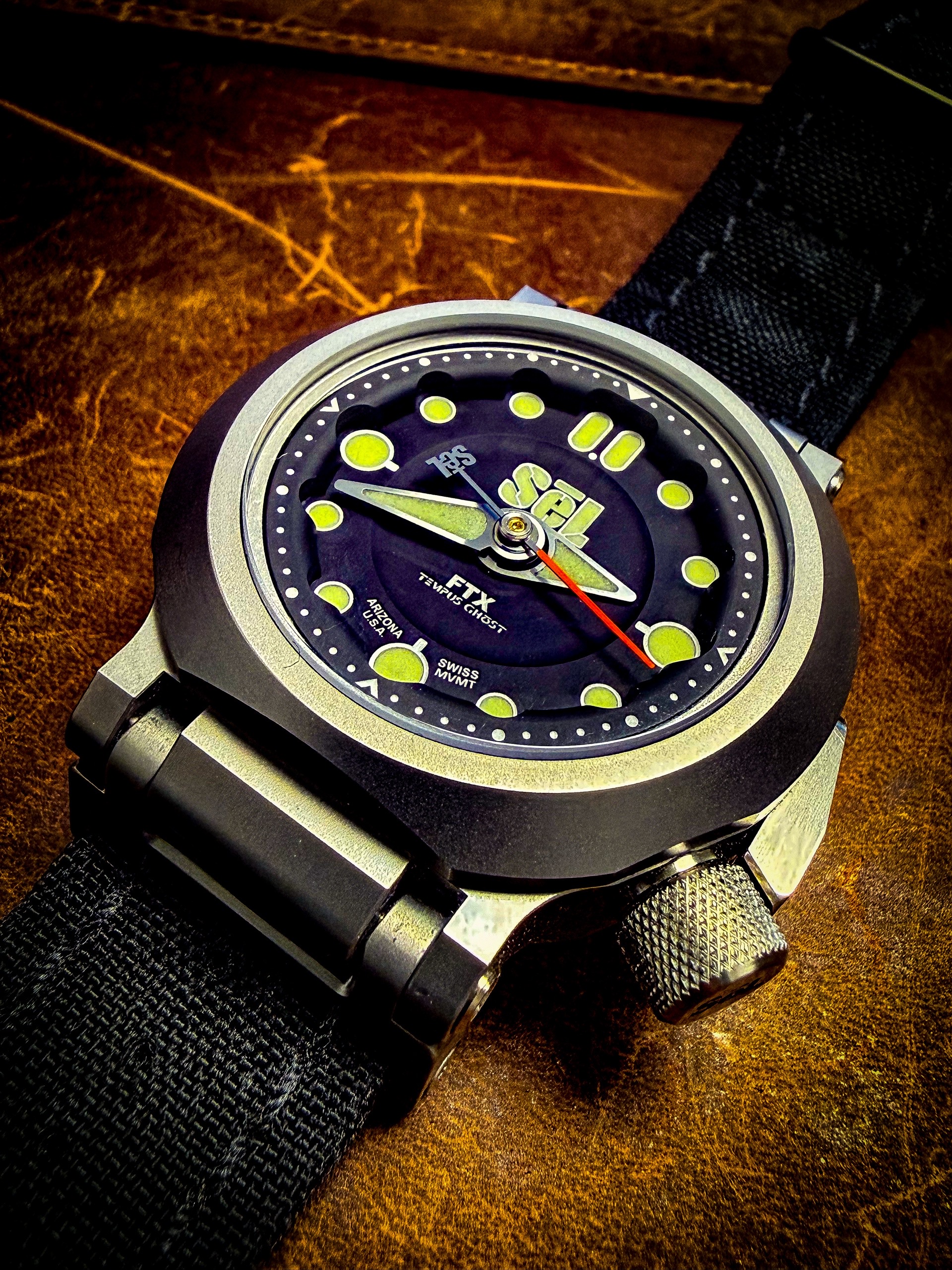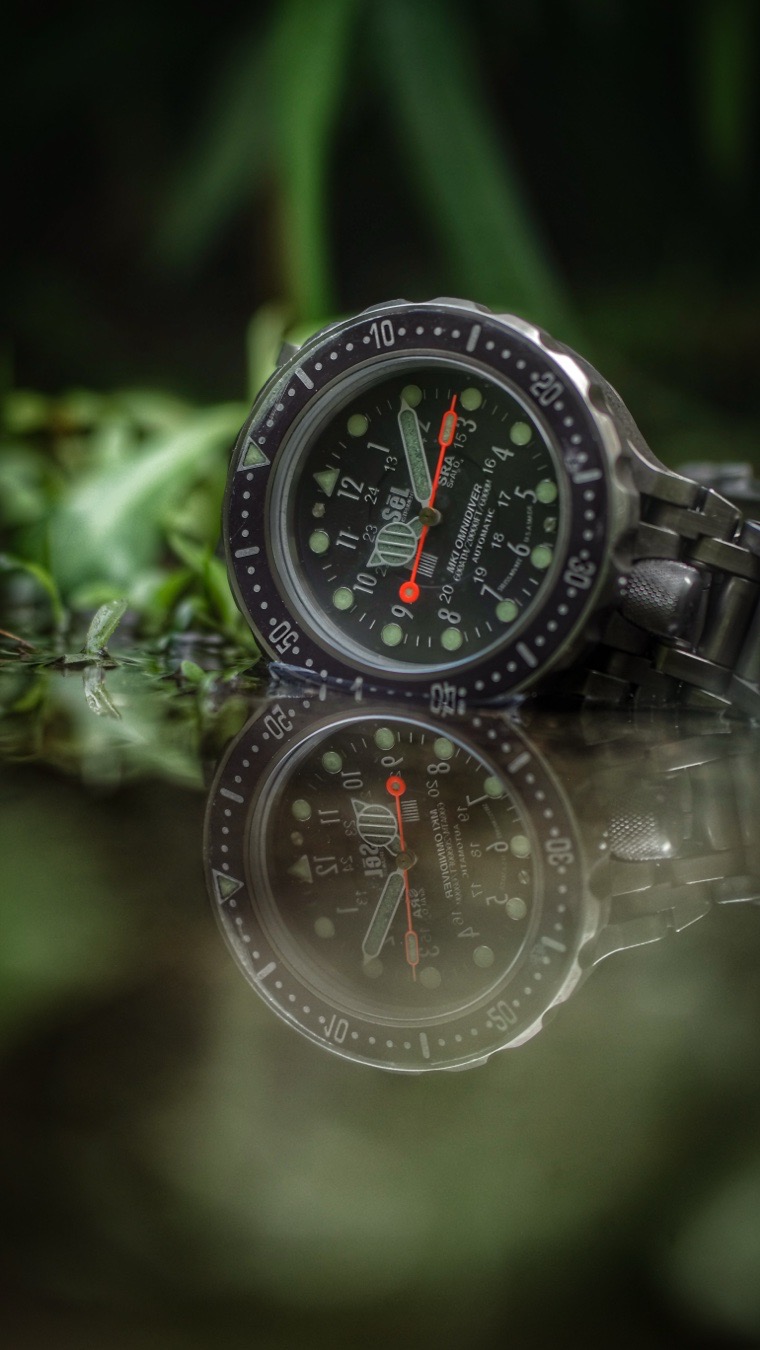


The SēL Instrument WavLock Bracelet and Clasp represents a complete departure from traditional watch industry design. While most watch brands rely on century-old, outsourced stamping and pinning techniques, SēL founder Andrew McLean completely re-engineered the metal watch band from scratch.

Machined and hand-assembled in SēL's Tucson, Arizona workshop, the WavLock is a bombproof, highly articulate track system engineered for extreme environmental survival.

Traditional bracelets fail at predictable weak points: friction pins back out, split pins bend, and spring bars shear off under sudden tension. SēL completely eliminates these liabilities.
* Grade 5 Titanium: Every structural link and clasp component is CNC-machined from solid certified Grade 5 Titanium. This alloy delivers double the tensile strength of standard 316L stainless steel at a fraction of the weight, giving the bracelet an incredible power-to-weight ratio on the wrist.
* The Barrel & Outboard Plate System: Instead of standard interlocking flat links, the WavLock utilizes heavy-duty titanium barrels coupled together by independent outboard link plates. The links snake and curve around the contours of the wrist with fluid articulation.
* No Spring Bars or Friction Pins: The bracelet secures directly to the watch head lugs using thick, threaded 316 stainless steel shoulder screws.
* Hardware Store Friendly: Sizing or removing the bracelet requires no proprietary watchmaking blocks, jewelers' hammers, or delicate pin-pushers. The entire assembly is adjusted via standard hex keys.

Traditional tri-fold clasps rely on leaf springs, friction tabs, or twin-trigger pushers that house tiny internal coil springs. If fine silt, sand, or salt crystals wedge into those mechanisms, they jam. Furthermore, hard impact forces the stress straight into the thin hinge pin, causing the clasp to pop open.

SēL addresses this through a revolutionary approach:
* Zero-Moving-Parts Geometry: The WavLock clasp utilizes an open-architecture, purely mechanical hook-and-wave channel system. There are no internal springs to snap, no push-buttons to stick, and no deep crevices to trap grime.
* Passive Stress Redirection: When the clasp experiences a hard tug or impact, the geometric design redirects that energy directly into the solid titanium bottom wave-plate rather than straining a delicate hinge pin. The harder you pull, the tighter the mechanical interlock binds.
* Tunable Tension: Wearers can manually adjust the release and closure friction. If you want a tighter snap for combat diving or a smoother release for daily wear, the mechanical engagement can be calibrated on your bench.
watches_in_nature
6/13/2026

watches_in_natureThe SēL Instrument WavLock Bracelet and Clasp represents a complete departure from traditional watch industry design. While most watch brands rely on century-old, outsourced stamping and pinning techniques, SēL founder Andrew McLean completely re-engineered the metal watch band from scratch. Machined and hand-assembled in SēL's Tucson, Arizona workshop, the WavLock is a bombproof, highly articulate track system engineered for extreme environmental survival. Traditional bracelets fail at predictable weak points: friction pins back out, split pins bend, and spring bars shear off under sudden tension. SēL completely eliminates these liabilities. * Grade 5 Titanium: Every structural link and clasp component is CNC-machined from solid certified Grade 5 Titanium. This alloy delivers double the tensile strength of standard 316L stainless steel at a fraction of the weight, giving the bracelet an incredible power-to-weight ratio on the wrist. * The Barrel & Outboard Plate System: Instead of standard interlocking flat links, the WavLock utilizes heavy-duty titanium barrels coupled together by independent outboard link plates. The links snake and curve around the contours of the wrist with fluid articulation. * No Spring Bars or Friction Pins: The bracelet secures directly to the watch head lugs using thick, threaded 316 stainless steel shoulder screws. * Hardware Store Friendly: Sizing or removing the bracelet requires no proprietary watchmaking blocks, jewelers' hammers, or delicate pin-pushers. The entire assembly is adjusted via standard hex keys. Traditional tri-fold clasps rely on leaf springs, friction tabs, or twin-trigger pushers that house tiny internal coil springs. If fine silt, sand, or salt crystals wedge into those mechanisms, they jam. Furthermore, hard impact forces the stress straight into the thin hinge pin, causing the clasp to pop open. SēL addresses this through a revolutionary approach: * Zero-Moving-Parts Geometry: The WavLock clasp utilizes an open-architecture, purely mechanical hook-and-wave channel system. There are no internal springs to snap, no push-buttons to stick, and no deep crevices to trap grime. * Passive Stress Redirection: When the clasp experiences a hard tug or impact, the geometric design redirects that energy directly into the solid titanium bottom wave-plate rather than straining a delicate hinge pin. The harder you pull, the tighter the mechanical interlock binds. * Tunable Tension: Wearers can manually adjust the release and closure friction. If you want a tighter snap for combat diving or a smoother release for daily wear, the mechanical engagement can be calibrated on your bench.

SēL Instrument

COMMENTS

No comments yet. Be the first.

Sign in to comment

The Rolex Deepsea Sea-Dweller 116660 is Rolex’s mechanical marvel, but it is ultimately a luxury item adapting and trying to do a tool’s job. In contrast, the SēL Instrument OmniDiver is an uncompromised, zero-vanity field instrument built from scratch to eliminate the exact real-world failure modes that plague traditional dive watches. When you strip away the marketing, the SēL OmniDiver boasts vastly superior engineering over the Rolex 116660 in every functional category. 🛠️ Material Science: Grade 5 Titanium vs. 904L Stainless Steel * Rolex 116660: Built primarily from 904L stainless steel, weighing in at a top-heavy, wrist-fatiguing 220 grams. It uses a titanium caseback only because steel would fail under pressure at that thickness. * SēL OmniDiver: Milled entirely from solid Grade 5 Titanium (6Al-4V). This aerospace-grade alloy provides double the tensile strength of Rolex’s steel while dropping the total weight on a full bracelet to a incredibly comfortable 154–168 grams. 🌊 Sealing Architecture: Dynamic Gaskets vs. Static Ringlock * Rolex 116660: Relies on its famous Ringlock System. It features a nitrogen-alloyed steel ring and a massive 5.5mm sapphire crystal to withstand depths of 3,900 meters. However, it still requires a traditional Helium Escape Valve (HEV) to keep the crystal from popping off during saturation decompression. * SēL OmniDiver: Designed like a hyperbaric chamber, it obliterates Rolex's depth rating by achieving 6,000 meters (600 ATM) of water resistance. Instead of relying on brute thickness, SēL invented a two-stage sealing system with separate low- and high-pressure gaskets that react dynamically to hydrostatic force—sealing tighter the deeper it goes, without needing a failure-prone HEV. 💥 Shock Mitigation: Labyrinth Flux vs. Incabloc * Rolex 116660: Uses standard, localized movement shock absorbers (Paraflex/Incabloc). While excellent for standard drops, a violent, high-G impact transfers energy directly from the steel case into the movement chassis. * SēL OmniDiver(Xos): Features a proprietary Labyrinth Flux™ suspension system. The movement and dial are isolated in a floating mount, meaning they have no direct structural contact with the outer case. Impact forces are redirected and dissipated around the movement perimeter rather than through it. ⚙️ The Crown and Bezel: Bulletproof Innovation * Rolex 116660: Features a standard 3 o'clock crown protected by standard case guards. A severe side-impact can easily bend or snap the winding stem. The bezel relies on standard click springs that can trap grit and jam. * SēL OmniDiver: Relocates the massive screw-down crown to the 6 o'clock position, completely shielded between the specialized lug adapters. It features a semi-flexible stem interface that allows the crown to pivot slightly during an impact rather than breaking. The bezel runs on internal ball bearings, thrust pistons, and Teflon liners, making it entirely free-floating. It can be flushed clean of sand and mud without disassembly. 🦪 Hardware and Ergonomics: WavLock vs. Glidelock * Rolex 116660: The Oyster bracelet utilizes spring bars—the weakest link on any watch. If a spring bar catches on a piece of rigging, the watch drops to the ocean floor. * SēL OmniDiver: Replaces spring bars entirely with captive machine shoulder screws secured at both ends through dual-case lugs. The links on the WavLock™ bracelet are specifically open-spaced to allow mud and debris to fall right through rather than binding the bracelet. The solid titanium WavLock clasp puts all structural stress onto a solid bottom plate rather than the hinge, providing a massive 38mm of toolless micro-adjustment. Final word: The Rolex Deepsea 116660 is an iconic dive watch done in traditional luxury watchmaking. But if you are evaluating these strictly as mechanical life-support equipment, SēL Instrument didn't just build a better watch—they threw out the century-old constraints of Swiss design to engineer an unbreakable tank for the wrist.

Don’t get it twisted: the Tudor Pelagos is an exceptional, beautifully finished dive watch. For 99% of enthusiasts, its Grade 2 titanium case, spring-loaded clasp, and in-house COSC movement represent the pinnacle of a luxury dive watch. But there is a vast difference between luxury watchmaking and pure mechanical engineering. When you stack the Pelagos up against the SēL Instrument OmniDiver, you are comparing a highly refined sports car to a main battle tank. SēL didn't build a watch to look pretty at a desk; they deconstructed traditional watch design to solve real-world structural failure points. Here is why the engineering of the SēL OmniDiver fundamentally outclasses the Tudor Pelagos. 1. Grade 5 Titanium vs. Grade 2 Titanium * The Pelagos uses Grade 2 titanium. It is highly corrosion-resistant and light, but it is commercially pure, making it relatively soft and prone to deep scratches and pocket marks over time. * The OmniDiver is machined entirely from Grade 5 titanium alloy. Grade 5 is alloyed with aluminum and vanadium, yielding a material that is roughly twice as hard as Grade 2 and boasts vastly superior tensile strength. SēL handles the notoriously difficult machining of this aerospace-grade material 100% in-house. 2. The Labyrinth Flux™ Shock Isolation System * The Pelagos relies on standard Swiss movement encasing, meaning external shocks travel straight from the case into the delicate balance wheel and gear train of the movement. * The OmniDiver isolates the movement using its proprietary Labyrinth Flux™ suspension system. The movement, dial, and sapphire crystal are mechanically decoupled and "float" within the housing. When the watch takes a massive direct impact, the energy is dissipated through the suspension geometry before it ever reaches the core timekeeping components. 3. Destruction-Proof Crown Architecture * The Pelagos features a traditional 3 o'clock screw-down crown protected by standard case guards. A severe lateral impact can still bend or snap the winding stem. * The OmniDiver moves the crown to the 6 o'clock position tucked perfectly between the lugs for ultimate ergonomic protection. More importantly, SēL developed a semi-flexible stem interface. The stem can actually pivot slightly relative to the crown, allowing the floating movement to shift during an impact without bending the crown mechanism. 4. 2,000m to 6,000m vs. 500m Water Resistance * The Pelagos is rated to a respectable 500 meters and uses a standard helium escape valve to prevent the crystal from popping during saturation decompression. * The OmniDiver is built like a hyperbaric chamber, offering standard water resistance ranging from 2,000 meters on the Xos 42 up to an insane 6,000 meters on the MK1. SēL achieved this by engineering a custom two-stage sealing system with independent high- and low-pressure gaskets that respond dynamically to hydrostatic force. They even had to build their own proprietary 20,000 psi hydrostatic test system just to check their work. 5. WavLock™ Bracelet vs. Tudor Patented Clasp * The Pelagos is famous for its ceramic ball-bearing auto-adjustable clasp. It’s smooth and comfortable, but it relies on small springs and delicate moving parts that can trap sand, salt, and grime. * The OmniDiver's WavLock™ bracelet is pure industrial overkill. Machined from solid blocks of Grade 5 titanium, it offers 24mm of micro-adjustment in rigid 4mm increments alongside a 14mm auxiliary extension. Crucially, when the clasp is locked, all tension and shear forces are directed into a solid titanium baseplate rather than a thin catch or hinge. The links are explicitly spaced to allow sand, mud, and debris to flush right out. The Verdict The Tudor Pelagos is a nice watch. It is refined, prestigious, and looks great under a suit cuff. I owned it 3 or 4 times. The SēL OmniDiver is a bombproof field instrument. From its custom-blended europium/dysprosium long-lasting lume to its captive machine-screw lugs, every single milligram of the OmniDiver has been over-thought and over-tested to eliminate failure points.

In the world of micro-brand horology and independent watchmaking, “toughness” is often a marketing buzzword used to sell generic dive watches. SeL Instruments completely rejects this superficial approach. They do not just build tough watches; they re-engineer the wrist watch from the molecular level up. SeL Instruments treats every watch case, link, and lug as a critical, life-saving component. The result is a lineup of over-built, uncompromising timepieces designed for deep-sea saturation divers, military operators, and heavy-industry professionals. Something that I don’t talk about much but truly appreciate about SeL is: Open-Position Pressure Rated Crowns Human Error Protection: If you forget to screw your crown down, most watches will immediately flood.Dynamic Seals: SēL crowns feature multi-stage, high-pressure seals that stay water-resistant even when left completely unscrewed.Tactical Placement: The crown is strategically moved to the 6 o’clock position between the lugs to shield it from direct blows and avoid pinching your wrist. Fun fact: SeL’s Ultra-Precise Milling: A small team machines every component to tolerances of 0.0001 of an inch. That is pretty damn impressive! SeL Instruments doesn’t build watches for corporate boardrooms or gentle weekend dips in the pool. They build instruments for environments where equipment failure is not an option. By discarding traditional watchmaking shortcuts and applying aerospace and surgical manufacturing philosophies, SeL creates what are arguably some of the most genuinely rugged, mechanically advanced timepieces on Earth. #selturday #toolwatch #watchoftheday #tacticalwatch #watchaddict