The Journal By Nick·November 5, 2026· 6 min read
Depancel Autosport Les 2 Tours d'Horloge Race-Timer
By Nick·November 5, 2026· 6 min readThe new Depancel Autosport "Les 2 Tours d'Horloge" is a triple-calendar watch limited to 100 pieces. It ingeniously repurposes its month display into a manual 24-hour race counter for endurance events.
0 views
IN THIS ARTICLE
- 01A Dial Designed for the Pit Wall
- 02The 24-Hour Race Counter
- 03Completing the Calendar
- 04Powered by the Miyota 9122
- 05Positioning and Context
- 06Straps, Availability, and Specifications
- 07What is the 'Les 2 Tours d'Horloge' race?
- 08How does the 24-hour race counter work on the Depancel Autosport?
- 09Is the Depancel Autosport 'Les 2 Tours d'Horloge' a chronograph?
- 10What movement does the Depancel Autosport use?
- 11How many pieces of the Autosport 'Les 2 Tours d’Horloge' were made?
The new Depancel Autosport “Les 2 Tours d’Horloge” is a triple-calendar watch with a clever function. Limited to just 100 numbered pieces worldwide, it starts at $795 and repurposes its month display into a manual 24-hour race counter. It's a watch designed and assembled in France for a very specific endurance race.
39mmCase
$795Price
40hPower Reserve
50mWater Res.
The watch is a tribute to the "Les 2 Tours d'Horloge," which translates to "The Two Turns of the Clock." This is not just a name; it’s the only 24-hour non-stop endurance race in the world reserved exclusively for historic racing cars. The event, created in 1992 by Éric Van de Vyver, tests vintage GTs, Touring Cars, and Sport Prototypes at France's Circuit Paul Ricard.
Depancel's limited edition is built to be a functional instrument for that very race. Instead of a typical chronograph, it uses its calendar complication in a way that directly engages with the 24-hour format of the event.
Depancel Autosport: The 'Two Turns of the Clock' Edition
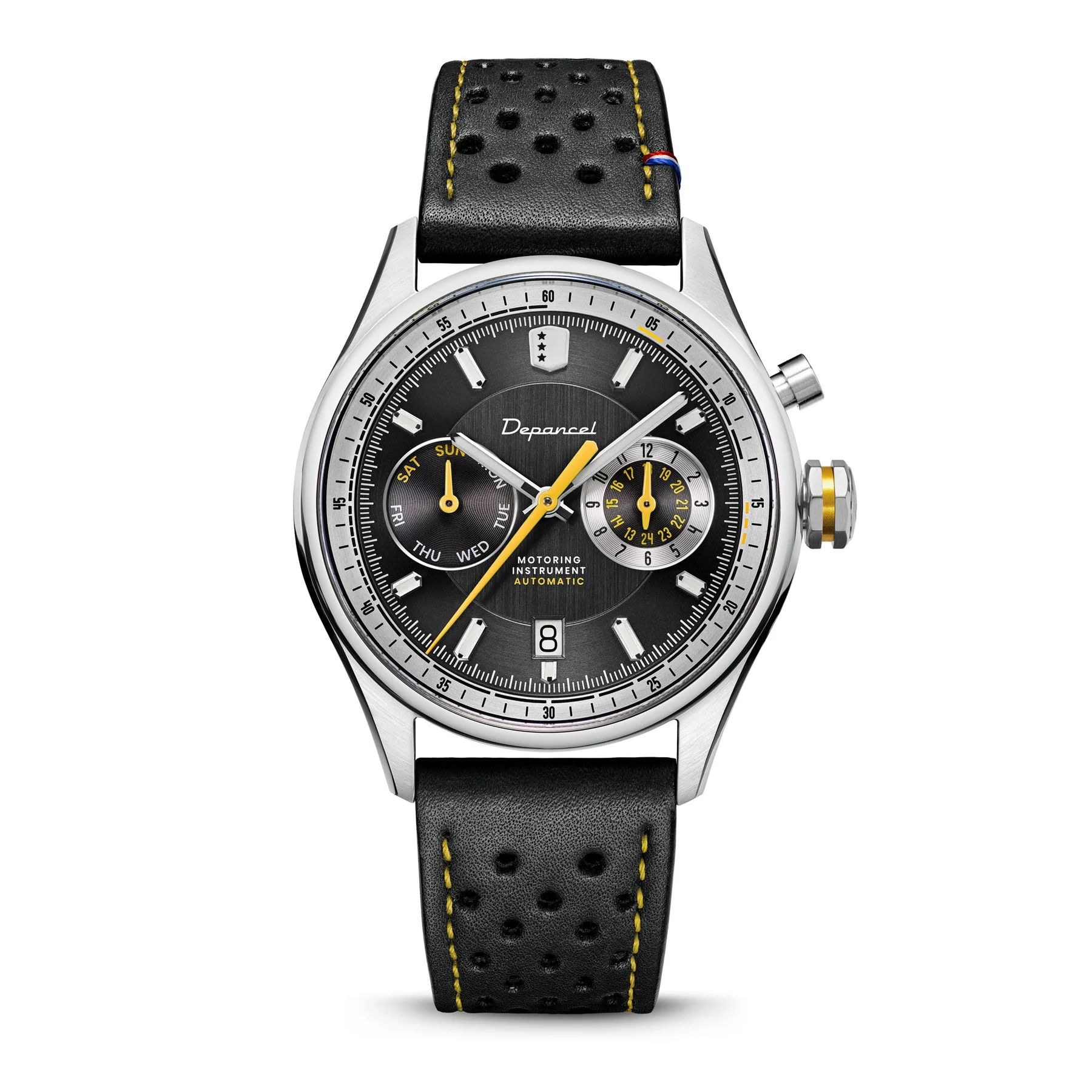
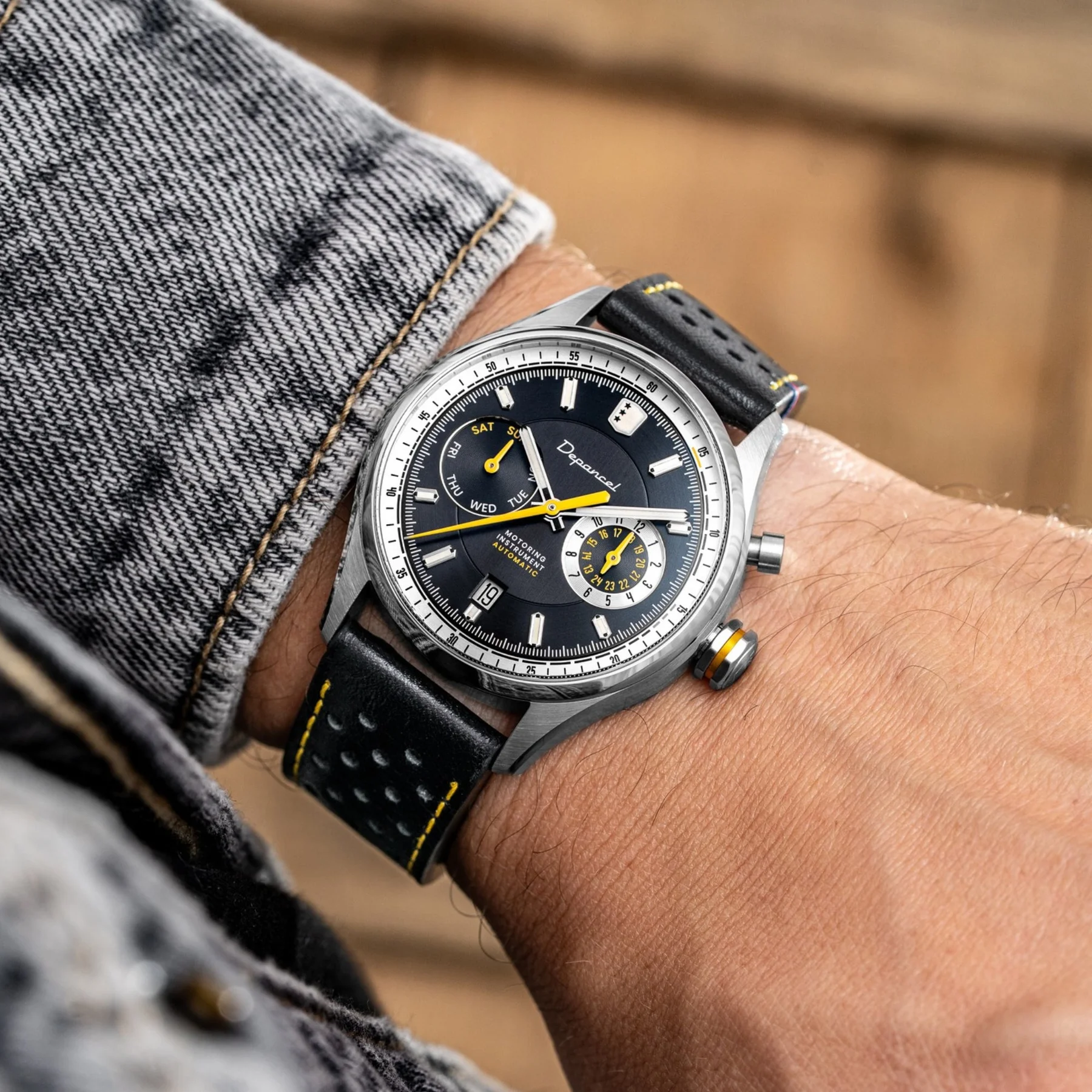
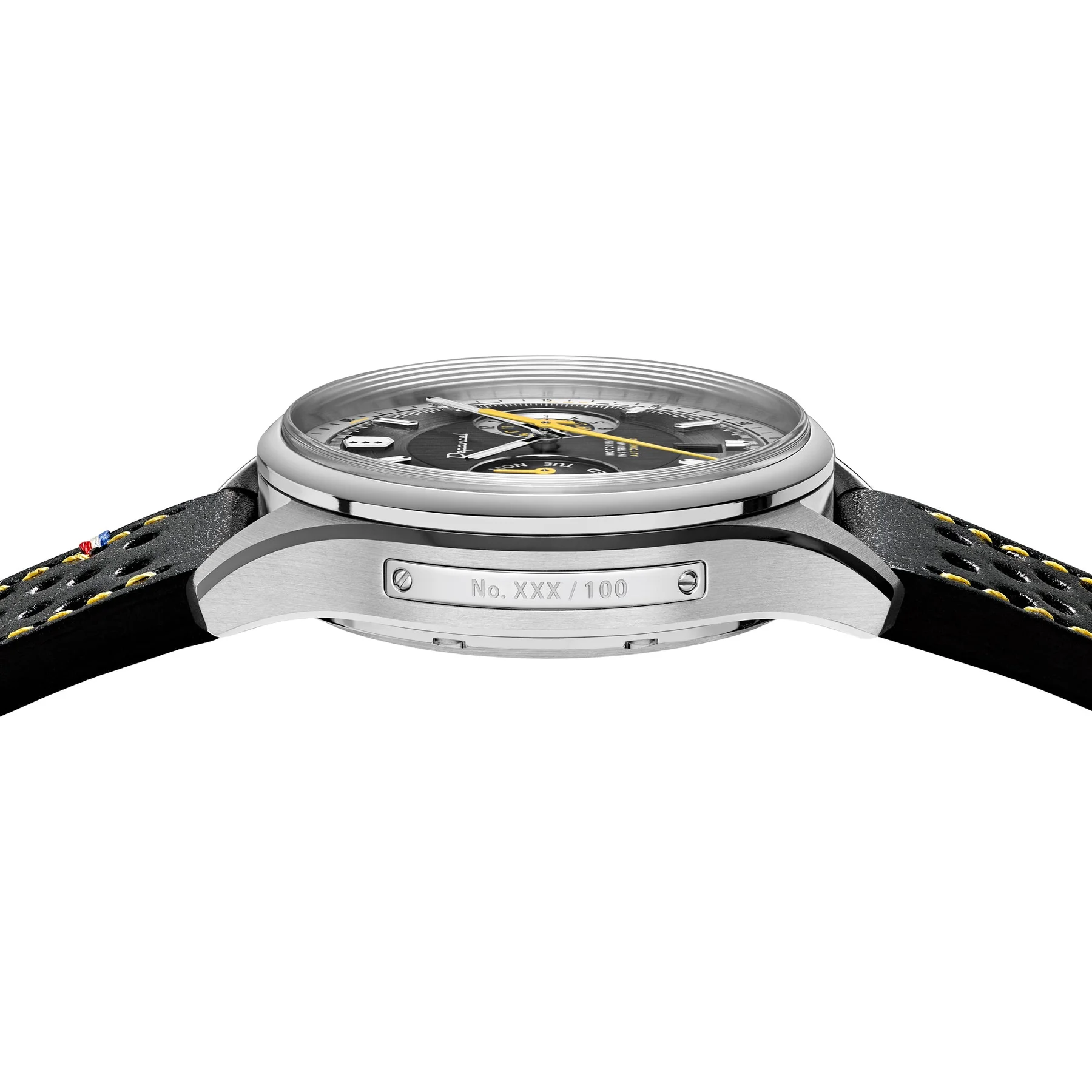
The foundation of this special edition is a 316L stainless steel case measuring 39mm in diameter with a 46mm lug-to-lug distance. These dimensions suggest a versatile fit for a modern sports watch, avoiding the oversized feel common in the category. Total thickness is 12.6mm, including a double-domed sapphire crystal.
Depancel applied a mix of finishes to the case. The bezel is polished, contrasting with circular brushing on the lugs and horizontal brushing on the case flanks. Polished upper chamfers add another layer of definition, echoing the varied metalwork of classic race car components and dashboard instruments.
A Dial Designed for the Pit Wall
The black dial is all about texture and legibility. The main surface has vertically brushed sectors, while the subdials are recessed with a guilloché pattern. The mix of textures is something any dialhead will notice immediately.
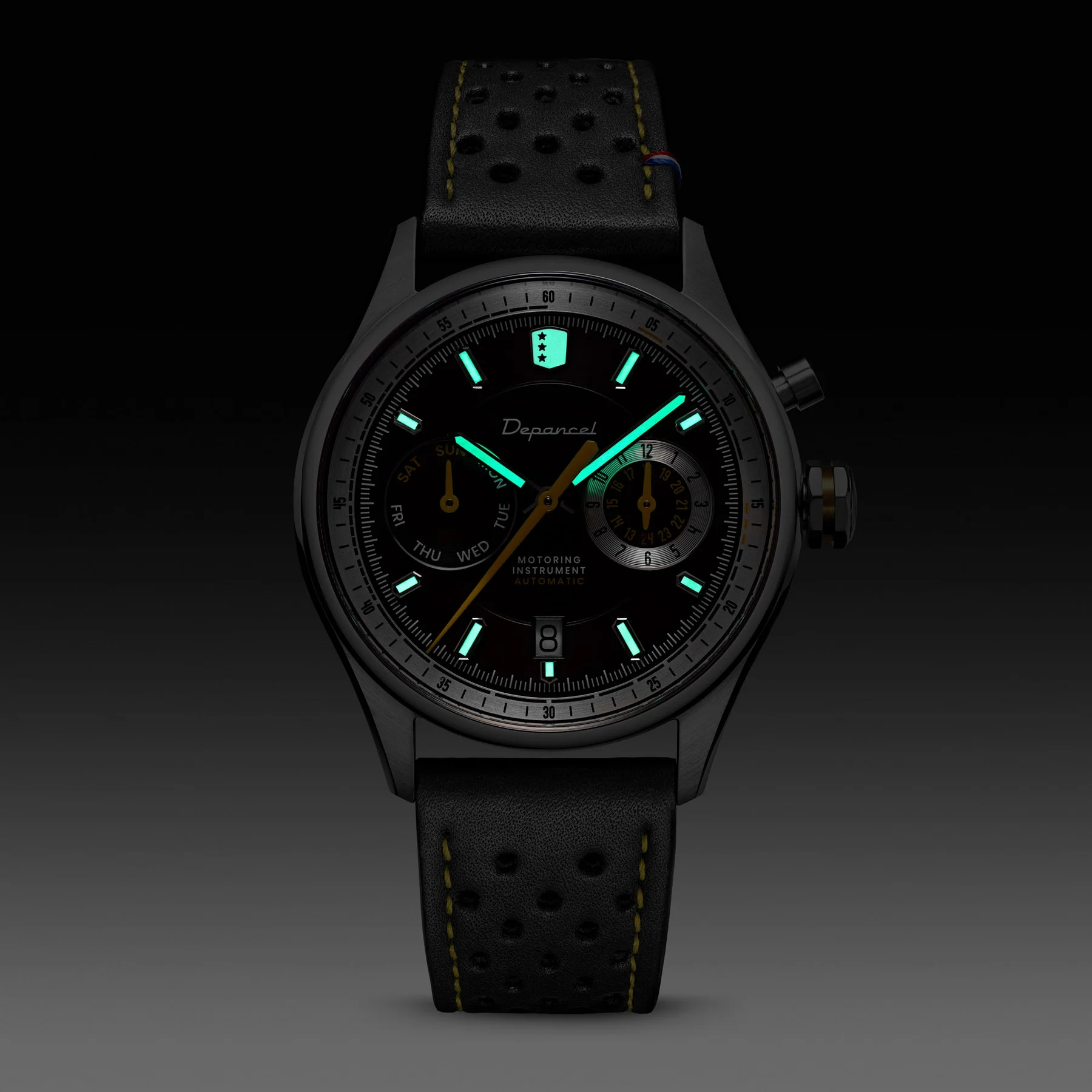
Applied faceted baton indices mark the hours, with Super-LumiNova C1 for low-light visibility on both the markers and hands. At 12 o'clock sits the Depancel three-star shield emblem. Above 6 o’clock, the text "Motoring Instrument" is printed, with "Automatic" highlighted in a vibrant yellow that carries across the dial accents.
The 24-Hour Race Counter
The watch’s main feature is the 3 o’clock subdial. It has a dual-scale display with an outer silver ring marked 1 to 12 in black and an inner black ring marked 13 to 24 in yellow. For most of the year, the 1-12 scale functions as a standard month indicator.
During race weekend, it becomes an interactive hour counter. The pusher at 2 o'clock, typically used for setting the month, is repurposed. A press at the end of each completed hour manually advances the hand, allowing a driver or team member to track elapsed time over the full 24-hour event.
The pusher at 2 o'clock isn't for a chronograph. It manually advances the 3 o'clock hand, turning the month indicator into a 24-hour race tally for endurance events.
Completing the Calendar
The rest of the layout is a clean triple-calendar. The subdial at 9 o'clock displays the day of the week, with "Saturday" and "Sunday" highlighted in yellow to signify the two race days. A framed date aperture sits at 6 o’clock.
This layout means the watch serves two distinct purposes. It's a functional, interactive timing tool during the race and a classic automatic triple-calendar watch the rest of the year.
Powered by the Miyota 9122
Inside is the Japanese Miyota 9122 automatic caliber. It operates at 28,800 vibrations per hour (4 Hz) and provides a 40-hour power reserve. This movement drives the hours, minutes, central seconds, and all three calendar functions.
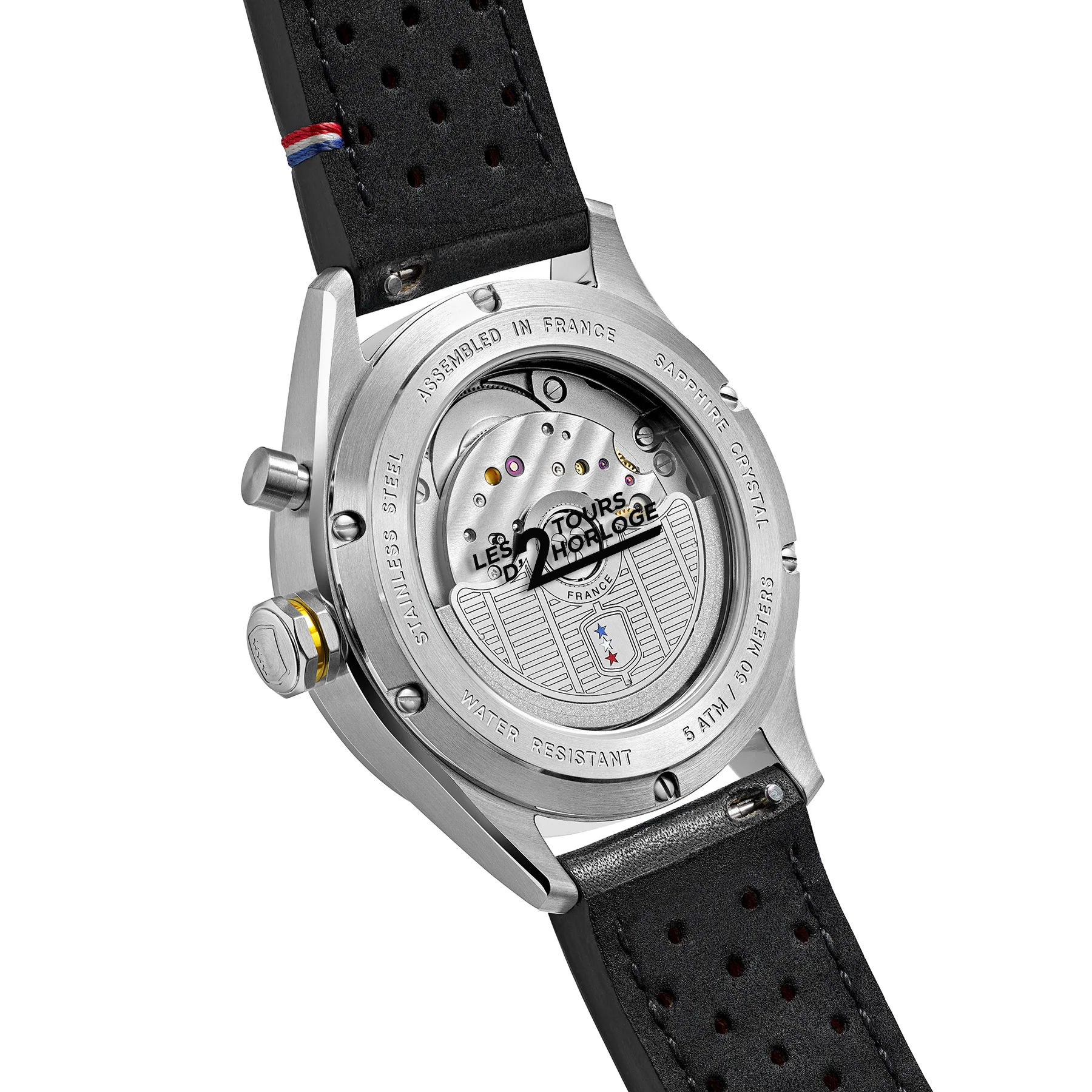
It’s a reliable and widely used movement that provides the necessary triple-calendar complication for this watch's unique function. Through the exhibition sapphire caseback, Depancel has fitted a custom oscillating weight decorated with an automotive radiator-grille motif and the brand's shield emblem.
Positioning and Context
This isn't Depancel's first motorsports-inspired piece we've covered. While the Série-R Skeleton focused on the mechanical complexity of a column-wheel chronograph, this Autosport edition delivers its function through clever dial design. It’s a different approach to the same automotive passion.
The watch offers a distinct alternative in the market for affordable motorsport timepieces. It stands apart from meca-quartz models like the Timex Waterbury Heritage Chronograph by providing a fully automatic, triple-calendar complication tied to a specific racing story.
Straps, Availability, and Specifications
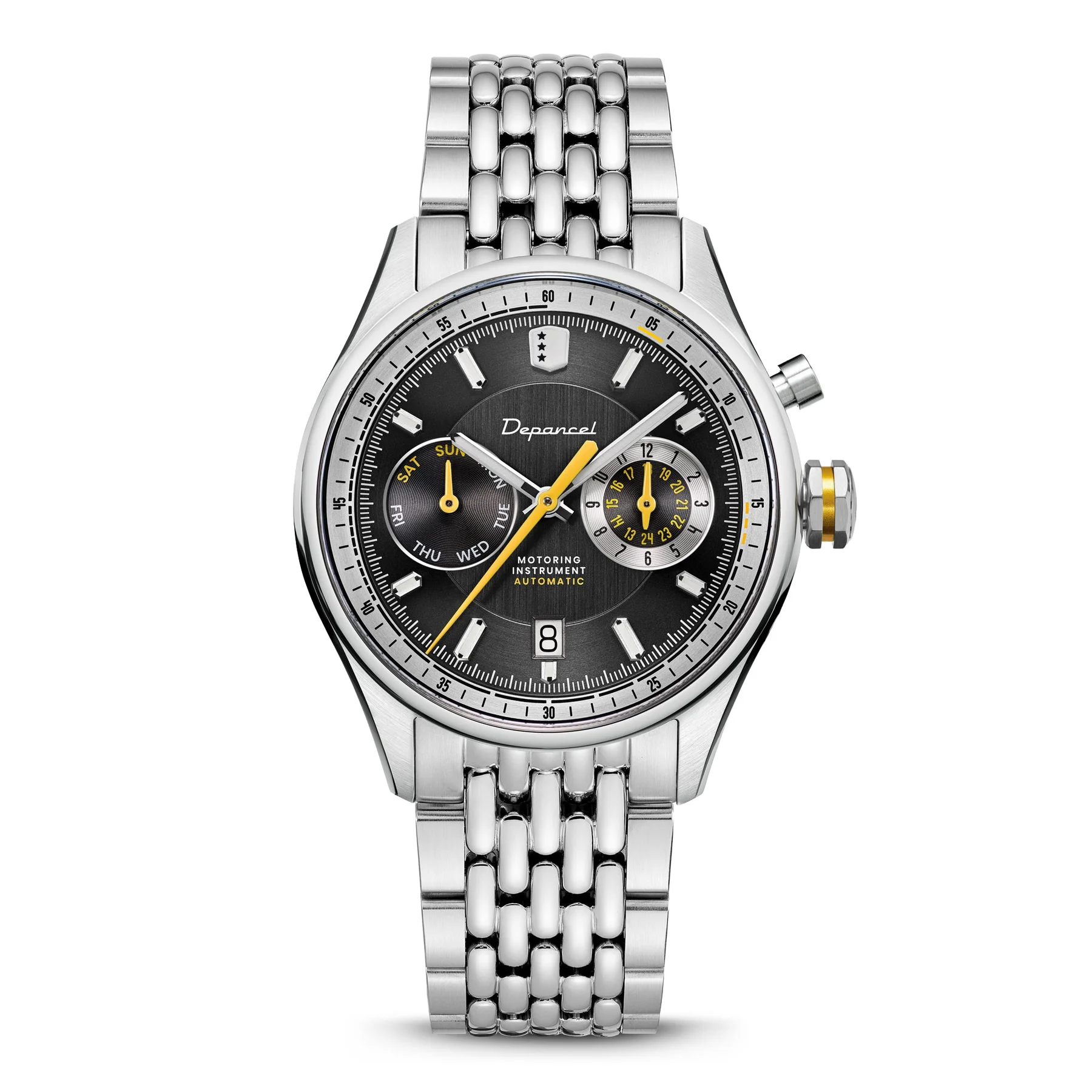
The watch is available on two strap options: a black perforated leather racing strap with yellow contrast stitching, or a 316L stainless steel Beads of Rice bracelet. The launch is set for November 5, 2026, with only 100 numbered pieces available. Depancel states the edition will never be reproduced.
| Model | Autosport – Les 2 Tours d’Horloge |
| Case Material | 316L stainless steel |
| Case Dimensions | 39mm x 46mm x 12.6mm |
| Lug Width | 20mm |
| Movement | Miyota 9122 automatic |
| Power Reserve | 40 hours |
| Frequency | 28,800 vph (4 Hz) |
| Water Resistance | 50 meters / 5 ATM |
| Crystal | Double-domed sapphire (front), sapphire exhibition caseback |
| Lume | Super-LumiNova C1 |
| Strap/Bracelet | Perforated leather strap or steel Beads of Rice bracelet |
| Price | Starts at $795 USD |
The Takeaway
The Depancel Autosport “Les 2 Tours d’Horloge” is a tool watch for a very specific job: timing a 24-hour historic race. For its $795 price, it delivers a unique manual complication within a well-proportioned 39mm case, positioning it as a story-driven piece for motorsport enthusiasts over spec-focused collectors.
Frequently Asked Questions
What is the 'Les 2 Tours d'Horloge' race?
Created in 1992, "Les 2 Tours d'Horloge" (The Two Turns of the Clock) is the only 24-hour endurance race in the world dedicated exclusively to historic racing cars. It is held at the Circuit Paul Ricard in France and features vintage GT, Touring, and Sport Prototype cars.
How does the 24-hour race counter work on the Depancel Autosport?
The subdial at 3 o'clock has a dual 1-12 and 13-24 scale. The pusher at 2 o'clock manually advances the hand. During the race, you press the pusher at the end of each hour to track the total hours elapsed up to 24.
Is the Depancel Autosport 'Les 2 Tours d'Horloge' a chronograph?
No, it is not a chronograph. It does not have a start, stop, and reset function for timing seconds and minutes. It is a triple-calendar watch with a modified complication that allows the user to manually track elapsed hours over a 24-hour period.
What movement does the Depancel Autosport use?
This watch uses the Miyota 9122 automatic movement. It is a Japanese-made caliber with a 40-hour power reserve that provides hour, minute, second, day, date, and month functions, which Depancel adapted for the race counter.
How many pieces of the Autosport 'Les 2 Tours d’Horloge' were made?
This is a limited edition of 100 individually numbered watches. According to Depancel, the model will not be produced again after the initial run is sold.
GALLERY
WRITTEN BY
Nick
I originally started VELOCE to put my skills to work, hone my app design and web development practices, and dive deeper into the world of horology. I wanted to learn more about the watches, the brands, and the incredible people behind them - the creators, the designers, and the collectors. I love discovering new timepieces and sharing their stories with the world. VELOCE is my ultimate passion project and hobby, the creative space I head to after my full-time job to build something I truly care about.